


.png)

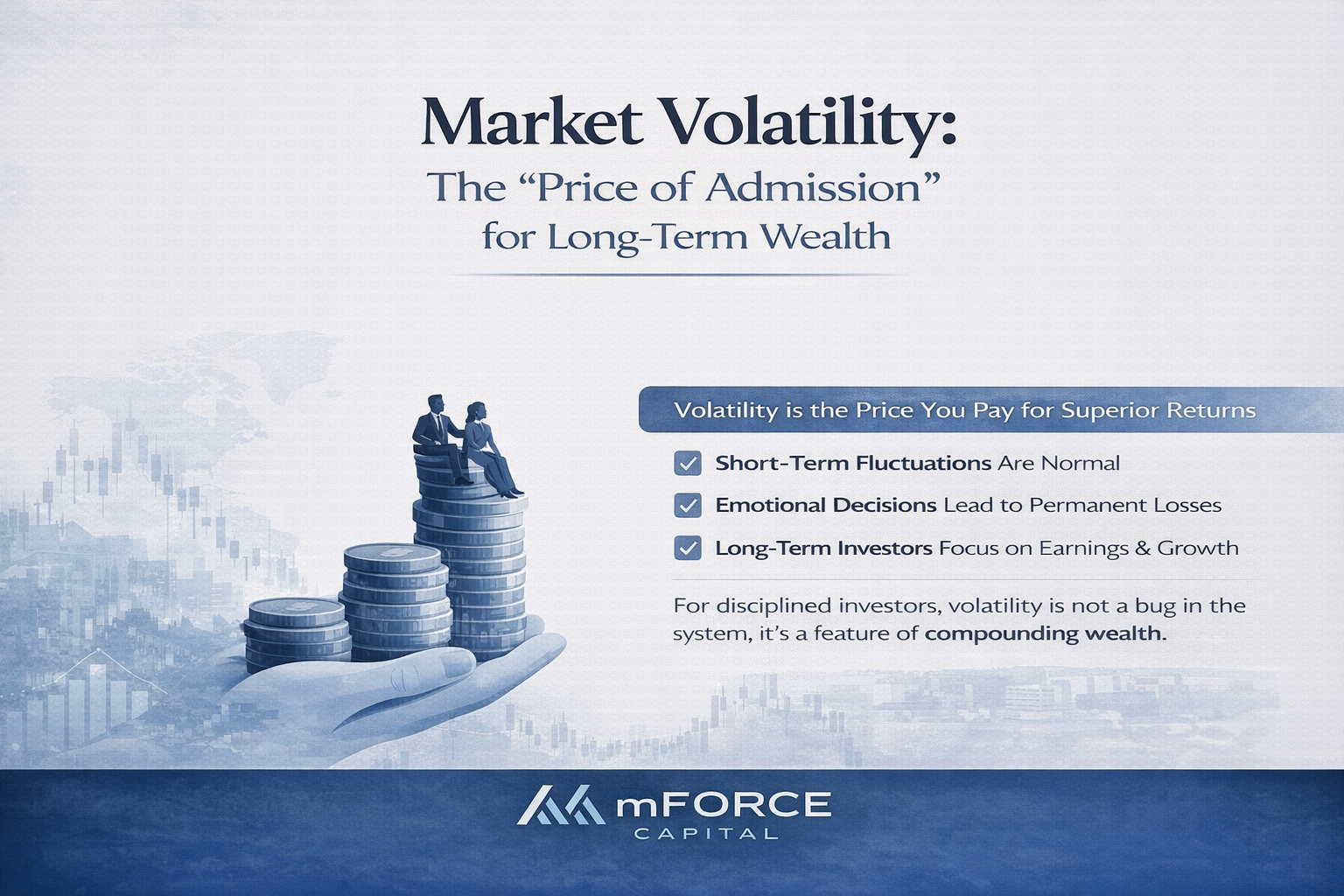
Market Volatility: The "Price of Admission" for Long-Term Wealth
For the disciplined investor, volatility is not a bug in the system; it is a feature. To achieve long-term growth that outpaces inflation and compounds wealth, one must accept short-term price fluctuations as the fundamental "price of admission."
What is Market Volatility?
Technically, volatility is the statistical measure of the dispersion of returns (often measured by standard deviation). In plain English: it is the frequency and magnitude of price swings. Volatility is merely a temporary divergence between the price of an asset and its intrinsic value.
The Math: Volatility vs. Permanent Loss
It is vital to distinguish between two concepts that are often conflated:
- Temporary Price Fluctuation (Volatility): The market "marking to market" your portfolio daily.
- Permanent Loss of Capital: Selling an asset during a downturn or investing in a business that goes to zero.
Historically, the S&P 500 has seen an average intra-year decline of approximately 14%, yet the market has ended the year with positive returns in 33 of the last 44 years. Volatility is the norm, not the exception. (Source, JP Morgan Asset Management Guide to Markets)
How Business Owners and Executives Can Handle Volatility Differently
If you own a private business or real estate, you don't ask for a valuation of your company every Tuesday at 10:00 AM.
Public markets should be viewed with the same detachment. The "ticker" is a servant, not a guide. As Carl Richards often illustrates, the "Behavior Gap", the difference between what an investment earns and what the investor actually keeps is almost always caused by reacting to short-term noise.
How to Navigate Uncertainty
- Identify the Signal, Ignore the Noise: Short-term movements are driven by sentiment; long-term outcomes are driven by earnings, dividends, and compound interest.
- Risk is Personal: Volatility only becomes a "risk" if it forces you to change a well-reasoned plan at the wrong time.
- Strategic Allocation: We build portfolios for UHNW families not for the "best-case" scenario, but to be resilient during the "worst-case" scenario.
Takeaway: Volatility is the price you pay for a premium return. If you aren't willing to pay the price, you cannot expect the reward.
Articles You May Also Find Helpful

The roadmap to financial success
A step-by-step PDF that outlines the key financial milestones individuals and families should aim for, including wealth preservation, estate planning, and legacy building.